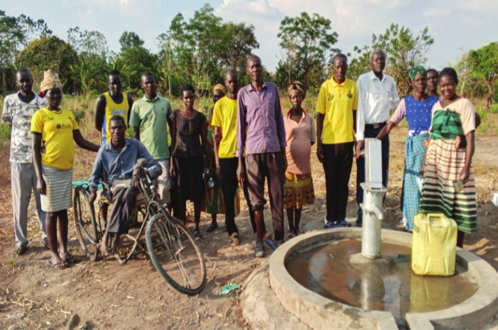
In Ajobi village, Alebtong District, 31-year-old Walter Ocero has lived with weakened legs since childhood illness robbed him of full mobility. He relies on a wheelchair provided by FRDC and on the constant support of his wife for most daily tasks. But it was his wife — not Walter himself — who was quietly carrying the heaviest burden of all.
The Daily Walk That Never Ended
Every morning, Walter's wife joined the women and children of Ajobi village on a two-kilometre walk to the neighbouring village of Inyiroiye. The destination was a seasonal stream that shrank to muddy pools in the dry season, or a shallow well so overcrowded that disputes broke out daily over who could draw water and when.
On good days, the round trip took nearly two hours. On bad days — when the stream had dried or the queue at the well had spilled into arguments — she returned home empty-handed. As her pregnancy advanced, those two-hour walks grew harder, the waits longer, and the empty returns more frequent.
Walter watched, and worried. He could not make the walk for her. He could not carry the jerricans. He could not solve what had no solution.
*'Searching for water caused arguments in my family,'* he recalls. *'My life depends on my wife's presence, yet she would spend hours away, sometimes coming back without water. With her pregnancy, the situation worsened. Water was always at the centre of my prayers.'*
One Request That Changed Everything
When a team of FRDC rehabilitation specialists visited Ajobi village to assess community needs, Walter saw his moment. His request to the team was quiet and precise:
'We need water, because if we have water, we have everything.'
That sentence became the mandate for what followed.
From Ground Breaking to First Pump
FRDC mobilised quickly. The community gathered for a groundbreaking ceremony at the chosen site — Walter's own compound — marking a moment of collective hope that had been building for years. Villagers from Ajobi, Enyirye, and Awelo came to watch, some having never seen a drilling rig before.
The drilling rig broke through the red laterite earth as the community stood by in quiet anticipation. When water rose — clean, cold, and abundant — the crowd erupted. A hand pump was installed, tested, and handed over to the community.
The borehole now serves **approximately 1,000 people across 350 households in three villages**.
Walter's Wife Fetches Water from Their Own Compound
The morning after installation, Walter's wife pumped water for the first time without leaving their home. The two-kilometre walk — the arguments, the waits, the empty jerricans, the exhausting returns — was over.
She now has the time and energy she could not spare before: to rest during her pregnancy, to care for their home, and to prepare for their newborn.
For Walter, the borehole means something beyond the practical. *'Clean water is not just convenience,'* he says. *'It is dignity. It is safety. It is opportunity.'*
He has already begun planning. With year-round access to water, Walter intends to grow vegetables throughout the dry season — using the borehole to sustain crops that could not survive before — and create a new source of income for his family.
What One Borehole Eliminated
Across the three villages now served, the impact has been immediate and measurable:
Waterborne diseases: significantly reduced — contaminated seasonal sources replaced
2-kilometre daily walk: eliminated for over 1,000 people
Domestic conflict: reduced — disputes over fetching responsibilities have eased
Girls back in school: — no longer pulled from class to collect water
Nutrition improved: — families can cook consistently without rationing water
Pregnant women protected: — no more long walks during pregnancy
A Prayer Answered
Walter prayed for water. FRDC delivered it to his doorstep — and with it, returned time to his wife, safety to his unborn child, income potential to his household, and dignity to a man who had spent years watching a problem he could not fix.
His story is one of hundreds that remind us why FRDC exists: because sometimes the difference between a life constrained and a life transformed is a single borehole, drilled in the right place, by people who listened.